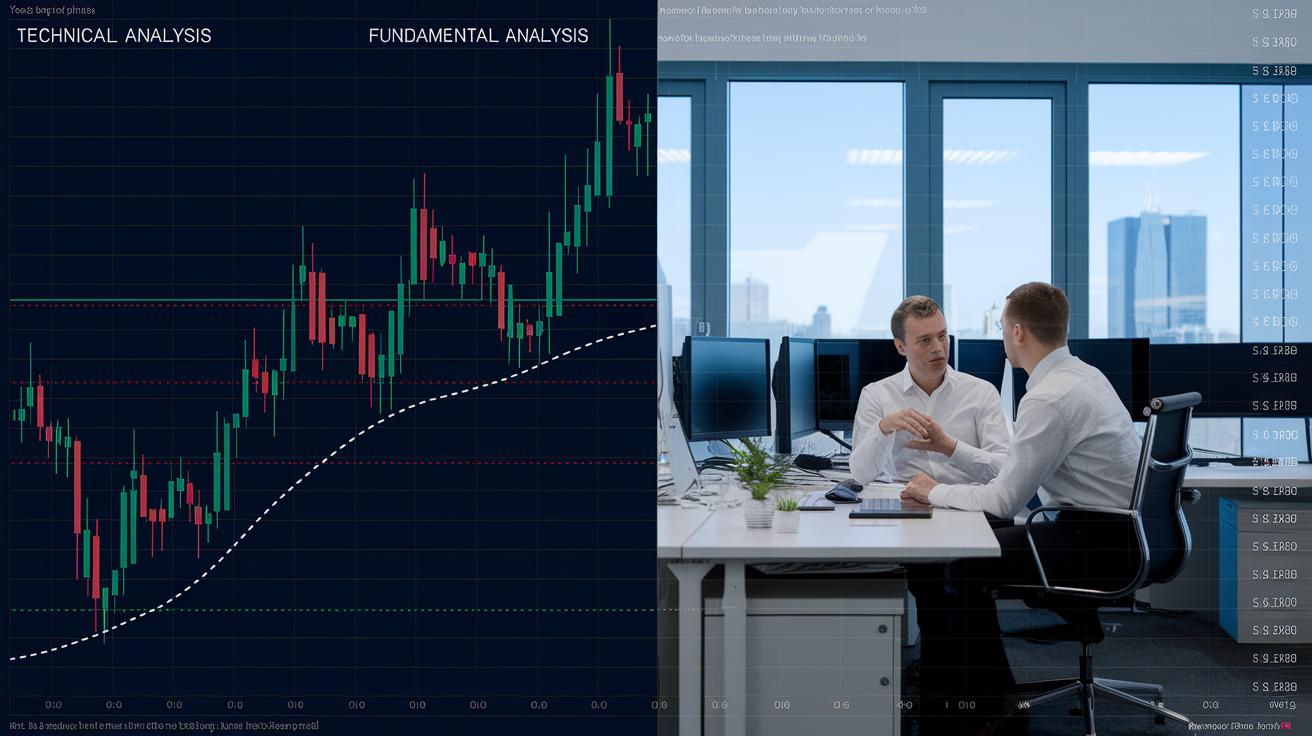
MARKET BRIEF: Technical vs Fundamental Analysis
Top line: Charts can catch quick market moves, while hard numbers point to long-term value.
So what: Knowing your style can shape your trading approach, whether you trade daily or plan for the future.
Ever wonder whether to lean on price charts or dig into a company’s fundamentals? The debate between technical analysis and fundamental analysis is ongoing. Technical analysis relies on charts and trends (patterns in price movement) to spot opportunities fast. In contrast, fundamental analysis digs into clear numbers like earnings and free cash flow (money left over after expenses) to find companies built to last.
If you are a day trader or a long-term investor, understanding which method fits your strategy can make all the difference. This guide explains both approaches so you can choose the right tool for today’s market conditions.
What to watch:
- For quick moves, monitor chart patterns.
- For long-term plays, check earnings and free cash flow figures.
Technical vs Fundamental Analysis (Which to Use When)
Fundamental analysis is best if you plan to invest over many years. It looks at key financial numbers like revenue, earnings, and free cash flow (the cash a company has after expenses) to spot strong companies that may be undervalued. This method works well for building long-lasting conviction in quality stocks. For example, an investor who targets dividend-paying companies might use these basics to secure steady growth.
Technical analysis, on the other hand, is ideal for catching short-term market moves. It uses price charts, moving averages (an indicator that smooths price data), and trading volume to decide when to enter or exit a trade. Traders in fast-moving fields like semiconductors and biotech often prefer this approach, as it helps them act quickly when prices shift.
- Steady performance in consumer staples and utilities: fundamental analysis.
- A breakout after strong earnings: technical analysis.
- Searching for reliable dividend payers with solid cash flow: fundamental analysis.
- Quick price swings in biotech showing momentum changes: technical analysis.
- Immediate trade signals from short-run market events: technical analysis.
Your choice depends on your trading timeframe and market conditions. If you want to uncover a company’s true worth and hold through market ups and downs, fundamental analysis lays a solid foundation. But if you need precise, short-term timing to catch price moves, technical analysis offers the right tools. Align your strategy with your risk tolerance and the current market scenario to get the best results.
Fundamental Analysis: Purpose, Components, and Strengths

Top line: Fundamental analysis measures a company's true value by taking a close look at its financials and overall business role.
Fundamental analysis digs into a company’s real worth using clear numbers and practical judgment. Analysts check revenue, earnings, and free cash flow (cash left after expenses) alongside softer factors like management quality and market position. This approach works best in steady industries such as utilities, healthcare, and consumer staples. Long-term investors often use these basics to build positions in firms that grow consistently over time.
What to watch: Look for steady revenue growth, healthy earnings, and robust free cash flow as signals of a strong business.
Key Components of Fundamental Analysis
The method relies on solid figures from financial reports like income statements, balance sheets, and cash flow statements. Key points include:
- Revenue trends that reflect market demand.
- Earnings showing profitability.
- Free cash flow indicating financial strength.
It also weighs quality factors like leadership and market share. This mix helps investors spot stocks that might be mispriced. For example, a trader might note steady revenue gains and solid market share, much like reporting that Tesla (TSLA, Nasdaq) delivered strong quarterly results backed by its leadership in electric vehicles.
So what: By combining clear numbers with practical insights, fundamental analysis builds conviction for long-term investments.
Strengths and Limitations
Fundamental analysis is strong for building long-term confidence. Take Berkshire Hathaway, for example, it posted a 19.9% compound annual growth rate from 1965 to 2024 by sticking with solid companies, compared to the S&P 500’s 10.4%, yet this method needs deep research and moves slowly. This can be a drawback if you need quick trade signals, making it ideal for value investing but less so for short-term trades.
Bottom line: Use fundamental analysis to understand a company’s intrinsic value if you plan to invest over the long term. For a detailed comparison between fundamental and technical analysis, visit https://bankingcorner.com?p=245
Technical Analysis: Key Tools, Patterns, and Strengths
Top line: Technical analysis uses charts and volume data to help traders spot short-term moves and decide when to buy or sell.
Technical analysis depends on simple price charts, like line, bar, or candlestick, and volume numbers to gauge where prices might head next. It uses graphical tools to spot patterns and give quick entry and exit signals. This method works especially well in fast-moving fields such as biotech and semiconductors, where around 80-89% of successful day traders rely on fast, chart-based setups. If you want to understand it in more detail, check out what is technical analysis.
Core Tools and Indicators
The approach rests on a few key tools. For instance, moving average crossovers send a clear signal when a short-term average crosses above or below a long-term one, hinting at a possible trend change. Support and resistance levels show price points where stocks usually struggle to fall lower or climb higher. If a security touches a support level, it might be a sign to consider buying. Fibonacci retracements help estimate how far prices could move back during a pullback. Oscillators like the Relative Strength Index (RSI) or stochastic indicators measure current momentum and can signal if a stock is overbought or oversold. For example, when a stock’s 20-day moving average crosses above its 50-day moving average, it often hints at growing momentum and may encourage traders to get in early.
Strengths and Limitations
One of the main strengths of technical analysis is its ability to offer fast, clear signals for entering or exiting trades. These quick cues can be vital in a fast-paced market. However, technical analysis overlooks a company’s fundamental health, which can matter when broader economic forces are at play. There’s also the risk of false breakouts if the signals are misread or if volume data isn’t strong. That’s why it’s smart to use multiple indicators together to confirm any signals and avoid reacting too rapidly to market noise.
Technical vs Fundamental Analysis: Side-by-Side Comparison in Market Conditions

Top line: This guide compares two main methods for studying market moves. Fundamental analysis looks at a company’s true value using earnings reports and cash flows, which works best for long-term holds. Technical analysis, on the other hand, uses price charts and market mood to catch quick moves, such as day trades or swing trades.
When you use fundamental analysis, you dive into a company’s key numbers like income statements and cash flow details. This method helps you see the company's real value over many years. Technical analysis watches price actions and trading signals to understand market sentiment and catch short-term moves.
| Criteria | Fundamental Analysis | Technical Analysis |
|---|---|---|
| Valuation Basis | Real value from income statements and cash flows | Price movements and market sentiment |
| Time Horizon | Multi-year outlook | Intraday to swing-trade cycles |
| Data Inputs | Financial ratios and economic data | Price charts, volume stats, and momentum tools |
| Ideal Sectors | Stable sectors like utilities and consumer goods | High-volatility sectors such as biotech and semiconductors |
| Decision Triggers | Key numbers like P/E and debt ratios | Chart patterns like breakouts and moving averages |
So what: Align your strategy with your market view. If you’re eyeing long-term value and solid economic data, fundamental analysis is your go-to. But if you’re looking to ride short-term price swings, technical analysis could be a better fit.
Technical vs Fundamental Analysis: Hybrid Strategies for Optimal Timing
Hybrid strategies use the best parts of both fundamental and technical analysis to choose entry points, fine-tune portfolios, and balance risk and reward. You start with a strong fundamental pick and then use technical clues and solid risk controls to make sure each trade fits your plan.
-
Fundamental Selection
Begin with a review of financial data. Look at important markers like dividend yield and cash flow strength. Define your goal, whether you want income or growth, and set a timeframe. For example, a stock with a high dividend and steady cash flow shows sound fundamentals. -
Technical Timing
After you pick strong stocks, watch for technical signals that mark the right time to buy. A typical sign might be a 3% drop below a 50-day moving average, hinting at a buying chance. Use data tools to make sure price moves match your view. -
Risk Management
Keep your risk in check with clear controls. Set limits on how much you can lose and keep a record of each trade. New AI tools can mix financial analysis with backtesting to automatically generate signals and help you stick to your portfolio plan.
Technical vs Fundamental Analysis: Common Mistakes and Best Practices

One common mistake is loading up on too many indicators or financial ratios at once. When you try to use too much data, it can cloud your judgment instead of clearing things up. For example, mixing a dozen oscillators and moving averages may slow you down rather than help you make a quick decision.
Skipping proper backtesting (testing your strategy using past data) or ignoring how reliable your signals are can leave you exposed when market conditions shift. Not setting firm risk versus reward limits can lead to heavy losses, and failing to note each trade reduces your chance to learn from mistakes. Using a strategy designed for one timeframe in a different trading style can throw off your whole approach.
Keep things simple with a few clear steps. Limit yourself to a small set of reliable indicators so your decisions remain focused. Set strict risk limits and backtest your setups consistently. Keep a detailed trade journal where you record your thinking, like noting, "Chose this trade because signal X, risk Y." Finally, make sure your analysis method fits your trading timeframe for a steady, reliable process.
Technical vs Fundamental Analysis: Real-World Case Studies and Investor Profiles
Top line: In March 2020, the market took a steep hit with the Dow Jones falling 26% in four trading days. Technical signals forced quick exits for day traders, while solid financials encouraged long-term buyers.
During the March 2020 downturn, the market nosedived as the Dow Jones plunged 26% over just four trading days. Technical analysis picked up a breach of key support levels, prompting many day traders to cut their positions and lock in gains. In fact, about 80–89% of active traders lean on these chart signals for quick decisions. At the same time, fundamental metrics suggested that despite the steep drop, some companies with strong financial health were simply caught in an overreaction, offering potential buying chances for those focused on long-term value.
Consider the approach of Warren Buffett. His method at Berkshire Hathaway (BRK.A, NYSE) delivered a 19.9% compound annual growth rate from 1965 to 2024. Instead of reacting to daily market swings like those seen during COVID-19, Buffett dug deep into income statements, revenue trends, and cash flow reports. Value investors following his method look for companies with steady earnings and robust balance sheets, trusting that prices will eventually reflect real business strength. This long-term focus contrasts markedly with the rapid technical setups favored by day traders.
What do these studies teach us?
- For day traders: Focus on short-term price patterns and clear technical signals.
- For long-term investors: Pay attention to a company’s financial history and intrinsic value metrics.
In short, technical analysis gives fast feedback during volatile periods, while fundamental analysis builds a strong, longer-term rationale. Each approach fits different trading styles and risk appetites.
Final Words
In the action, we weighed the benefits of technical and fundamental analysis methods. We looked at how fast-paced technical setups can guide short-term trades, while fundamental markers build confidence for the long run.
The discussion centered on technical vs fundamental analysis (which to use when) by highlighting clear signals and intrinsic value drivers. Blending both approaches may improve decision-making and risk control. Stay alert and keep refining your strategies for a brighter trading outlook.
FAQ
FAQ
Technical vs fundamental analysis which to use when Reddit
The discussion on Reddit about technical versus fundamental analysis highlights that long-term value relies on fundamental metrics, while short-term price action is best captured by technical indicators.
Technical vs fundamental analysis which to use when Forex
The debate for forex trading suggests that technical analysis is typically preferred to capture fast market moves, though fundamental insights can help form a broader economic perspective.
Fundamental analysis vs technical analysis PDF
The PDF comparing fundamental and technical analysis explains that fundamental analysis estimates intrinsic value using financial statements, while technical analysis relies on price patterns and indicators for timing trades.
Fundamental vs technical analysis which is better
The perspective on which is better depends on your strategy; fundamental analysis suits long-term investors targeting intrinsic value, whereas technical analysis works well for traders seeking precise entry and exit points.
Fundamental analysis vs technical analysis vs quantitative
The comparison between fundamental, technical, and quantitative methods shows that fundamental analysis focuses on financial health, technical analysis examines market moves, and quantitative analysis uses models to refine trading decisions.
Fundamental analysis vs technical analysis vs sentiment analysis
The overview of fundamental, technical, and sentiment analysis suggests that blending intrinsic value, price trends, and market mood can provide a well-rounded trading approach suited to different market conditions.
Technical and fundamental analysis in stock market
The combination of technical and fundamental analysis in the stock market allows investors to use core financial data for long-term choices while technical setups help time trades more effectively.
Fundamental and Technical analysis book
The book on fundamental and technical analysis details how these methods complement each other, offering insights on balancing thorough valuation with technical signals for more informed trading decisions.
Which is better, technical or fundamental analysis?
The answer depends on your goals; technical analysis is better for short-term trades with clear entry signals, while fundamental analysis works best for building long-term investment conviction.
What is the 3-5-7 rule in trading?
The 3-5-7 rule in trading offers a structured guideline where confirmation signals over 3, 5, and 7 periods help validate emerging trends before entering a trade.
Does JP Morgan use technical analysis?
The evaluation of JP Morgan’s strategy shows that large institutions often integrate both technical signals with fundamental analysis to support well-rounded trading and investment strategies.
What is the 90-90-90 rule for traders?
The 90-90-90 rule advises traders to meet a high threshold of confirmation—around 90%—across three critical metrics to enhance the chances of a successful trade execution.